Player Comparison: Joey O'Brien vs Guy Demel
17/02/1986 DOB 13/06/1981
27 Age 32
27 Age 32
17 Squad Number 20
5'10" Height 6'2"
West Ham United Career
30/07/2011 Joined 31/08/2011
Bolton Wanderers From Hamburger SV
Free Transfer Reported Fee £1,600,000
61(6) Appearances 39(3)
3 Goals 0
07/08/2011 Debut 29/11/2011
Cardiff City vs Middlesbrough
16/08/2011 Debut Goal n/a
Watford vs n/a
2012/13 Premier League
32(1) Apps 28(3)
2 Goals 0
2,717 Minutes 2,473
Analysis
To my mind, most of the starting XI for the coming season is settled. The majority of our line up is pretty clear cut, but there are still a couple of spots up for grabs. Last week, I tried to work out who should start in central defence against Cardiff City in 8 days time. Today, I want to take a closer look at our options for right back.
For the first time in my memory, we have two right backs who are more than capable of performing in the Premier League.
Guy Demel had an excellent season last year, getting forward regularly, forming a strong relationship with Ricardo Vaz Te on the right flank, he really recovered from a shaky debut season with the club.
Joey O'Brien also had a fantastic season (in fact, if it hadn't been for Winston Reid, the Irishman would've been my vote for Hammer of the Year). O'Brien was a model of consistency and reliability, putting in strong performances wherever he fit into the side, and making the absence of a top quality left back seem like a non issue.
To be honest, I don't think too many people would be too upset to see both of them continue as the fullbacks. However, the arrival of Razvan Rat, emergence of Dan Potts, and imminent return of George McCartney mean O'Brien will be moving back over to the right to compete directly with Demel for a starting position.
Defensive Play
When looking at the defensive game of these two players, there really is only one winner. Joey O'Brien performed admirably in defence last season, and the statistics show that he was streets ahead of Demel. Joey put in more tackles, and made more clearances and blocks than Demel in the league last year.
O'Brien was also more successful in the tackle, winning 82% (42) of his 51 attempted tackles (one tackle every 53.3 minutes, or 1.6 per game). Demel, on the other hand, won 77% (34) of the 44 he attempted (one every 56.2 minutes, or 1.4 per game).
The image below shows a break down of successful and unsuccessful tackles.

As mentioned above, O'Brien also completes more defensive actions per game (and at a higher frequency of minutes per action) than Demel. On average, O'Brien completed 7.1 defensive actions (clearances, blocks, interceptions) per game in the league last season, compared to Demel's 5.4.
However, there are a couple of defensive areas in which Guy does outperform his rival. Demel made 38 interceptions (1.2 per game) last season, meaning he snatched possession once every 65.1 minutes. O'Brien, on the other hand, managed just 30 (0.9 per game), at a rate of just one every 90.6 minutes.
Demel also posted a marginally better record when competing aerial duels. Of the 44 he competed (1.4 per game), he won 24 (55%), while O'Brien won 54% of his. However, the Irishman did compete in significantly more duels (72, 2.2 per game). Given the size difference between the two, perhaps indicating an area in which opposition sides feel O'Brien may be more vulnerable than Demel, thus targeting him aerial more often than the Ivorian?
The chart below shows the number of defensive actions per game of the two players.

Passing
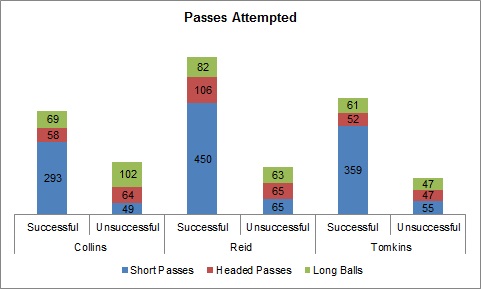
Interestingly, both fullbacks had very similar passing records for last seasons Premier League. Both posted an overall accuracy rate of 79%, and both passed at an incredibly similar frequency (2.93 mins per pass for O'Brien, 2.98 mins per pass for Demel).
Perhaps the biggest difference between the two, however, as the type of passing. Demel tended to favour a short passing game, with 83% of his passes going short. As many of us will recall, a large number of these passes will have been short up the line to Ricardo Vaz Te - Demel to Vaz Te was the most regular pass combination in a number of West Ham games last season.
O'Brien, on the other hand went long more regularly. 10.4% of his passes were long balls, compared to Demel's 8.6%. However, the difference in styles could be explained by the success of the long pass. O'Brien was accurate with 51% of his long balls, while Demel was accurate with just 32% of his.
The chart below shows the breakdown in pass types last season.

Offensive Play
If the main responsibility of a fullback is to defend, there is one winner. O'Brien is the more consistent and dependable defender. However, in the modern day the fullback is expected to contribute significantly to a teams attacking play.
On the surface, O'Brien appears a far more conservative fullback when compared with Demel. This is perhaps best represented by the massive difference in the crossing rate of the two. While O'Brien put in 12 successful crosses last season, and was unsuccessful with a further 19, Demel attempted a massive 83 crosses, hitting the mark with 30.
This means Demel put the ball into the box on average 2.7 times per game, or once every 29.8 minutes, whilst O'Brien did the same just once every 87.7 minutes, or 0.9 per game.
Although both enjoyed a similar success rate (39% for O'Brien, 36% for Demel), the intent displayed by the Ivorian demonstrates the attacking side of his game perfectly.
The image below shows a breakdown of crossing statistics.

However, that is not to say O'Brien isn't capable of attacking himself. Not only did he help himself to two goals last season, but he actually created more chances, and gained more assists than Demel.
O'Brien created 19 chances last season, with four of those ending up as assists. On the other hand, Demel created 18, with just two ended as assists.

To summarise, for the first time in a long time, we have a genuine dilemma over who to play at right back. We've had this before, but usually it's trying to decide who is the least awful.
It's a tough one, because both have areas of strength, and neither have any obvious weaknesses (although O'Brien in particular could be a little quicker).
O'Brien is the more dependable defender, tackling more regularly and successfully, and blocking and clearing more often. He also had a hand in more goals last season, scoring two and assisting four. However, he does have a tendency to sit a little deeper than Demel, putting far less crosses into the box.
Demel's qualities are there for all to see. He's rarely muscled off the ball, he's improved significantly on the nervous defender who played in the playoff final two years ago (7.6 errors (misplaced passes, tackled, poor control, dribbled by) per game last year compared to 7.1 for O'Brien). He also contributes greatly to our style of play. We rely a lot on feeding a high volume and quality of crosses into the box, and Demel provides a fantastic option getting the ball into the middle.
I compiled the stats for this post a few days ago, and I thought I'd decided who I'd rather start at right back next week then. Even starting out typing up my analysis just over 30 minutes ago, I was pretty clear in my mind who I would rather play.
But I think I've now changed my mind. He had a fantastic season last year, and was my dark horse for hammer of the year, but, if I were in Sam Allardyce's shoes, Joey O'Brien would just miss out to start the season.
The improvement in Demel's play last season was incredible. So many of us were nervous wrecks at the idea of him as our starting right back coming into the Premier League season, and he proved us all wrong. For me, he has become an extremely dependable fullback, and, perhaps more significantly, a very important component of our attacking play.
With the right wing slot still uncertain, the presence of Demel and his eagerness to whip the ball into the box will be very important to our side this season.
2012/13 Premier League
32(1) Apps 28(3)
2 Goals 0
2,717 Minutes 2,473
Analysis
To my mind, most of the starting XI for the coming season is settled. The majority of our line up is pretty clear cut, but there are still a couple of spots up for grabs. Last week, I tried to work out who should start in central defence against Cardiff City in 8 days time. Today, I want to take a closer look at our options for right back.
For the first time in my memory, we have two right backs who are more than capable of performing in the Premier League.
Guy Demel had an excellent season last year, getting forward regularly, forming a strong relationship with Ricardo Vaz Te on the right flank, he really recovered from a shaky debut season with the club.
Joey O'Brien also had a fantastic season (in fact, if it hadn't been for Winston Reid, the Irishman would've been my vote for Hammer of the Year). O'Brien was a model of consistency and reliability, putting in strong performances wherever he fit into the side, and making the absence of a top quality left back seem like a non issue.
To be honest, I don't think too many people would be too upset to see both of them continue as the fullbacks. However, the arrival of Razvan Rat, emergence of Dan Potts, and imminent return of George McCartney mean O'Brien will be moving back over to the right to compete directly with Demel for a starting position.
Defensive Play
When looking at the defensive game of these two players, there really is only one winner. Joey O'Brien performed admirably in defence last season, and the statistics show that he was streets ahead of Demel. Joey put in more tackles, and made more clearances and blocks than Demel in the league last year.
O'Brien was also more successful in the tackle, winning 82% (42) of his 51 attempted tackles (one tackle every 53.3 minutes, or 1.6 per game). Demel, on the other hand, won 77% (34) of the 44 he attempted (one every 56.2 minutes, or 1.4 per game).
The image below shows a break down of successful and unsuccessful tackles.

As mentioned above, O'Brien also completes more defensive actions per game (and at a higher frequency of minutes per action) than Demel. On average, O'Brien completed 7.1 defensive actions (clearances, blocks, interceptions) per game in the league last season, compared to Demel's 5.4.
However, there are a couple of defensive areas in which Guy does outperform his rival. Demel made 38 interceptions (1.2 per game) last season, meaning he snatched possession once every 65.1 minutes. O'Brien, on the other hand, managed just 30 (0.9 per game), at a rate of just one every 90.6 minutes.
Demel also posted a marginally better record when competing aerial duels. Of the 44 he competed (1.4 per game), he won 24 (55%), while O'Brien won 54% of his. However, the Irishman did compete in significantly more duels (72, 2.2 per game). Given the size difference between the two, perhaps indicating an area in which opposition sides feel O'Brien may be more vulnerable than Demel, thus targeting him aerial more often than the Ivorian?
The chart below shows the number of defensive actions per game of the two players.

Passing
Interestingly, both fullbacks had very similar passing records for last seasons Premier League. Both posted an overall accuracy rate of 79%, and both passed at an incredibly similar frequency (2.93 mins per pass for O'Brien, 2.98 mins per pass for Demel).
Perhaps the biggest difference between the two, however, as the type of passing. Demel tended to favour a short passing game, with 83% of his passes going short. As many of us will recall, a large number of these passes will have been short up the line to Ricardo Vaz Te - Demel to Vaz Te was the most regular pass combination in a number of West Ham games last season.
O'Brien, on the other hand went long more regularly. 10.4% of his passes were long balls, compared to Demel's 8.6%. However, the difference in styles could be explained by the success of the long pass. O'Brien was accurate with 51% of his long balls, while Demel was accurate with just 32% of his.
The chart below shows the breakdown in pass types last season.

Offensive Play
If the main responsibility of a fullback is to defend, there is one winner. O'Brien is the more consistent and dependable defender. However, in the modern day the fullback is expected to contribute significantly to a teams attacking play.
On the surface, O'Brien appears a far more conservative fullback when compared with Demel. This is perhaps best represented by the massive difference in the crossing rate of the two. While O'Brien put in 12 successful crosses last season, and was unsuccessful with a further 19, Demel attempted a massive 83 crosses, hitting the mark with 30.
This means Demel put the ball into the box on average 2.7 times per game, or once every 29.8 minutes, whilst O'Brien did the same just once every 87.7 minutes, or 0.9 per game.
Although both enjoyed a similar success rate (39% for O'Brien, 36% for Demel), the intent displayed by the Ivorian demonstrates the attacking side of his game perfectly.
The image below shows a breakdown of crossing statistics.

However, that is not to say O'Brien isn't capable of attacking himself. Not only did he help himself to two goals last season, but he actually created more chances, and gained more assists than Demel.
O'Brien created 19 chances last season, with four of those ending up as assists. On the other hand, Demel created 18, with just two ended as assists.

To summarise, for the first time in a long time, we have a genuine dilemma over who to play at right back. We've had this before, but usually it's trying to decide who is the least awful.
It's a tough one, because both have areas of strength, and neither have any obvious weaknesses (although O'Brien in particular could be a little quicker).
O'Brien is the more dependable defender, tackling more regularly and successfully, and blocking and clearing more often. He also had a hand in more goals last season, scoring two and assisting four. However, he does have a tendency to sit a little deeper than Demel, putting far less crosses into the box.
Demel's qualities are there for all to see. He's rarely muscled off the ball, he's improved significantly on the nervous defender who played in the playoff final two years ago (7.6 errors (misplaced passes, tackled, poor control, dribbled by) per game last year compared to 7.1 for O'Brien). He also contributes greatly to our style of play. We rely a lot on feeding a high volume and quality of crosses into the box, and Demel provides a fantastic option getting the ball into the middle.
I compiled the stats for this post a few days ago, and I thought I'd decided who I'd rather start at right back next week then. Even starting out typing up my analysis just over 30 minutes ago, I was pretty clear in my mind who I would rather play.
But I think I've now changed my mind. He had a fantastic season last year, and was my dark horse for hammer of the year, but, if I were in Sam Allardyce's shoes, Joey O'Brien would just miss out to start the season.
The improvement in Demel's play last season was incredible. So many of us were nervous wrecks at the idea of him as our starting right back coming into the Premier League season, and he proved us all wrong. For me, he has become an extremely dependable fullback, and, perhaps more significantly, a very important component of our attacking play.
With the right wing slot still uncertain, the presence of Demel and his eagerness to whip the ball into the box will be very important to our side this season.